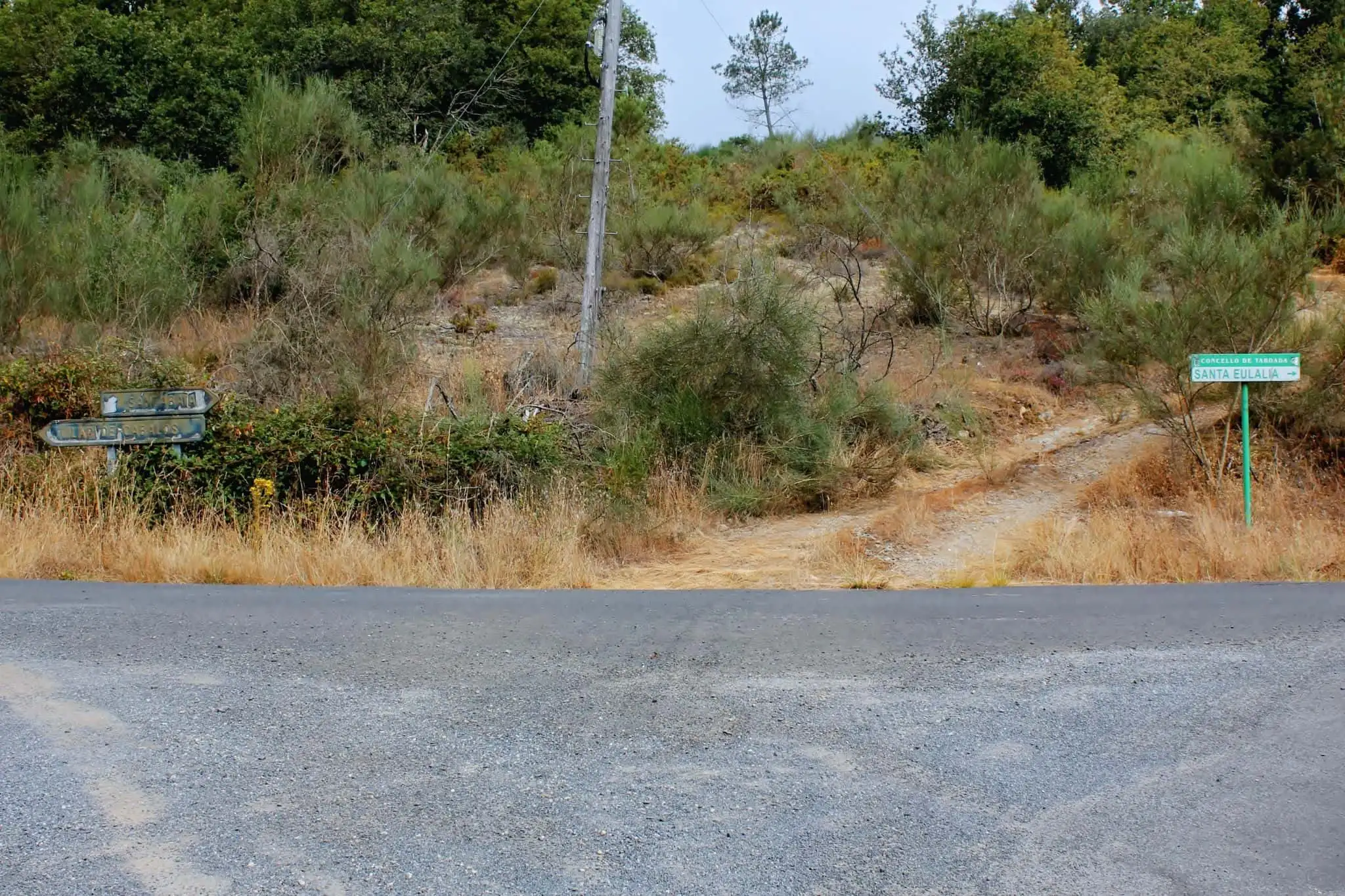
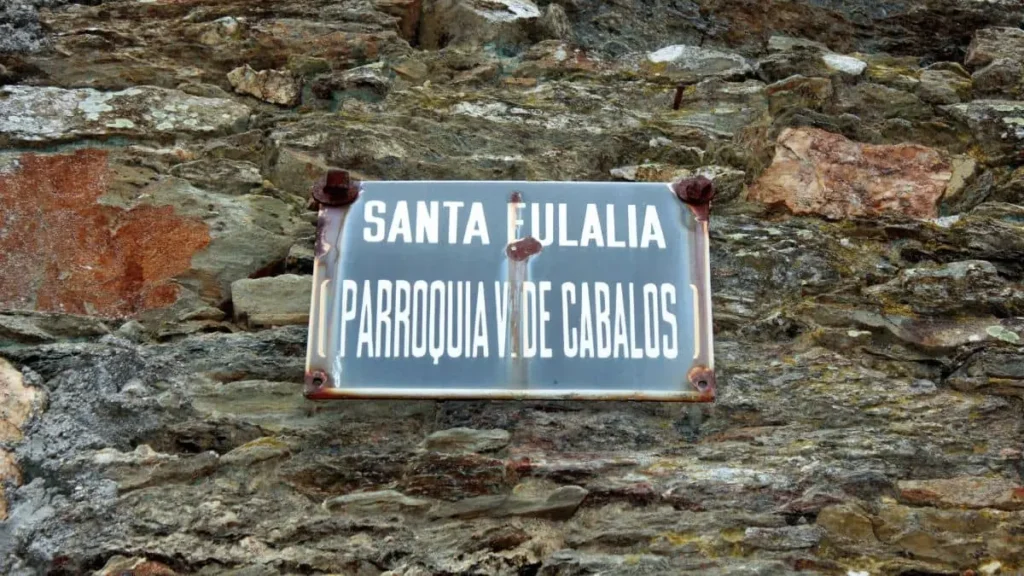
A few hundred metres outside the aldea where I live in Taboada, an old road sign points to Santabaia. It has weathered to the edge of illegibility. A newer sign stands close by, pointing the same way, and it says Santa Eulalia. Same saint, same road, twenty residents, and nobody appears to have thought either sign worth taking down.
The official register is stranger. In the state Nomenclátor, the parish is filed as Vilar de Cabalos (Santa Eulalia): it takes its administrative name from one settlement and its patron saint from another. Santa Eulalia the hamlet holds twenty people. Vilar de Cabalos the hamlet holds thirteen. The parish as a whole holds thirty-six. Somewhere along the line the parish changed its head village, kept the old saint in parentheses, and left the road sign in Galician while the register went to Castilian.
None of this is unusual here, which is the part worth explaining.
Across the twenty-six concellos of Ribeira Sacra, the 2025 padrón counts 68,255 residents spread across 444 parishes and 2,843 separately named places. That comes to twenty-four people per name. The median named settlement holds seven. Two hundred and eighty-four of them hold nobody at all — the name sits in the register with a population of zero.
The wider pattern is provincial. Lugo and Ourense have almost identical populations, around 326,000 and 305,000. Lugo distributes its people across 9,846 named places, Ourense across 3,712. One province names its ground nearly three times as finely as its neighbour, on the same rivers, under the same law.

The Hillock, the Church, the New House
Read down the list of the most common names and the reason starts to surface. Across the two provinces, 158 separate places are called Outeiro or O Outeiro. Then come Vilar, Castro, Igrexa, Torre, Pena, Casanova, Veiga, Campo, Ponte, Lama, Cimadevila. The hillock. The hamlet. The hillfort. The church. The tower. The rock. The new house. The river meadow. The field. The bridge. The mire. The top of the village.
Nearly five thousand of the registered forms keep their definite article: A Torre, O Outeiro, A Ponte. The tower. Which tower is a question the name declines to answer.
Fifty-seven per cent of named places in the two provinces carry a name that belongs to at least one other place. Inside Ribeira Sacra it is forty-five per cent. Roughly half the toponyms in this territory fail the one test a name is usually asked to pass.
Directions From Where You Are Standing
These names were never built to distinguish a place from every other place in Galicia. They were built to distinguish it from the three or four you can see from where you happen to be standing. There is one hillock in view, so it is the hillock. Six parishes away there is another one, and it is also the hillock, and no confusion arises because the two are never in the same field of vision.
Which reframes something visitors take as rural vagueness. Ask directions here and you will often be given a route with almost no names in it — past the church, up where the road forks, the house with the vines. Or you will be given a neighbour: the Ferreiro place, where So-and-so’s daughter lives. The neighbour is the precise coordinate. The toponym only resolves for someone already positioned to resolve it, and a stranger by definition is not.
The same logic runs through local announcements. Village events are published with a date, a saint and a parish, and frequently no address at all. Whether that is a mild form of protection or simply how the information has always been shaped, I have never been able to establish. Both readings are consistent with the evidence, and the people organising the fire are not troubled by the question. If you can find it, you were already meant to.
What the Register Had to Do
A national statistical system cannot work like this. Every unit needs a unique identifier, so the state had to force a relative vocabulary into an absolute schema — and the seams show.
Sabadelle appears in five concellos across the two provinces: Cervantes, Sarria, and three inside Ribeira Sacra — Chantada, Portomarín and O Pereiro de Aguiar. Three of the five are parishes, which the register separates by patron: Sabadelle (Santa María), Sabadelle (San Salvador), Sabadelle (San Martiño). The saint arrives as a disambiguator, doing the work a surname does elsewhere.
Even the saints are unstable. The register files twenty-nine parishes under (Santa Baia) and thirteen under (Santa Eulalia) — one saint, two languages, allocated with no discernible rule. The Real Academia Galega and the Xunta’s Toponymy Commission have spent decades restoring Galician forms that the twentieth century Castilianised. On my road the traffic went the other way, and neither sign has come down.
They have never been reconciled and probably never will be. The new one sits on a pole and comes loose in a strong wind, and when it does somebody from the aldea walks out and straightens it. Twenty people keeping upright a sign that points to where they already are.
Road signs at the Santa Eulalia crossroads; parish plaque inside the aldea — photos by P. Vanossi.