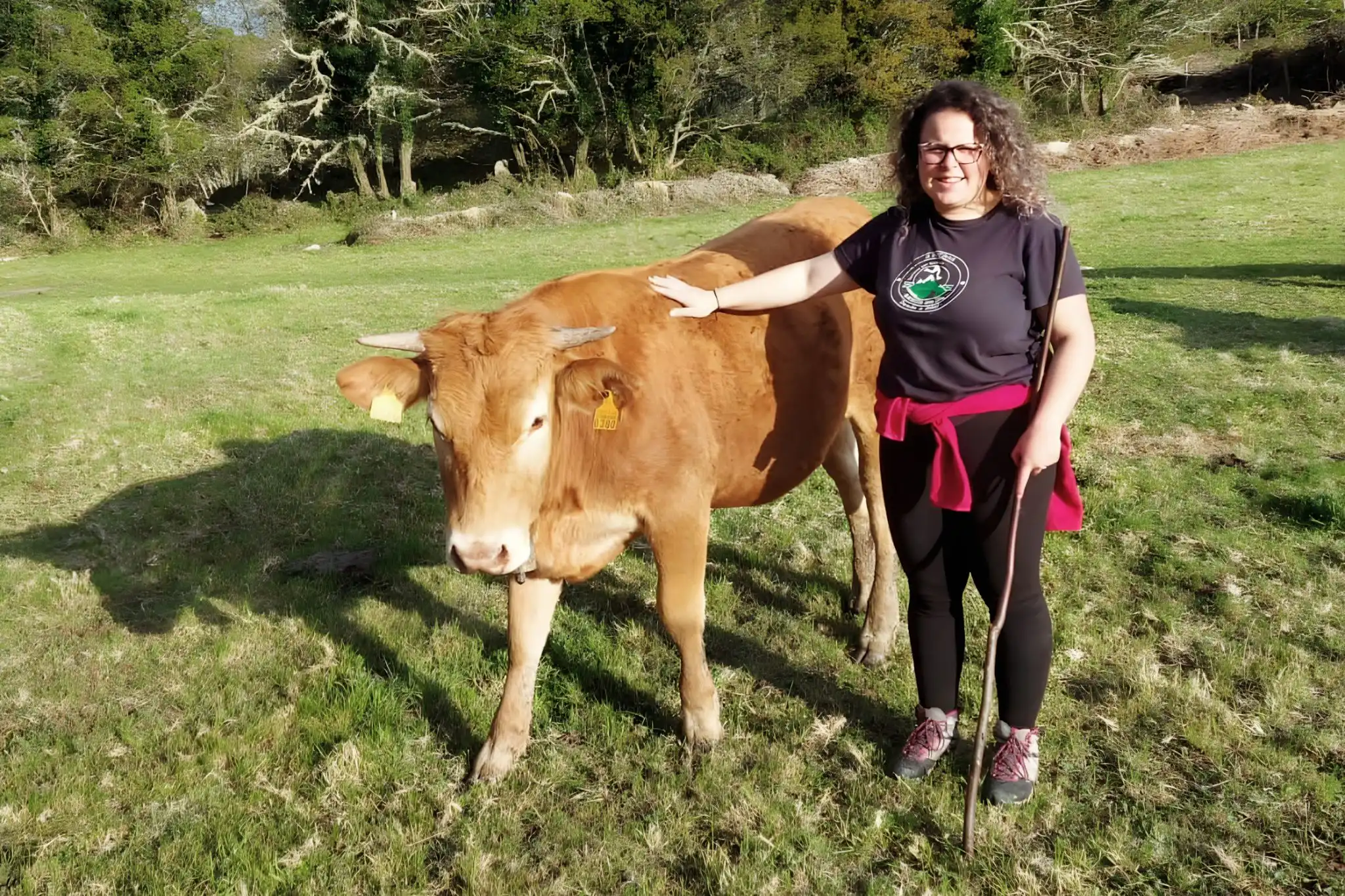
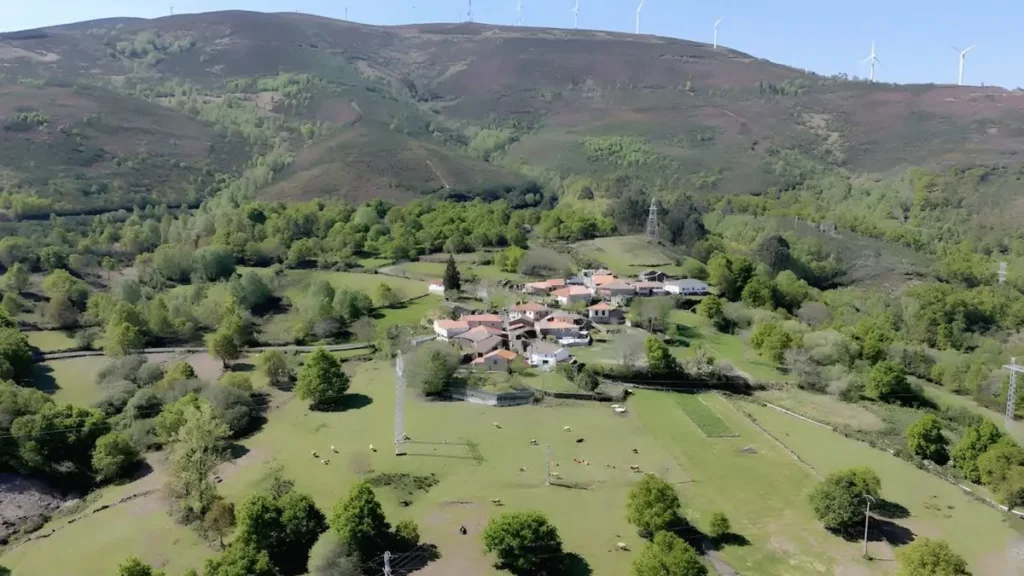
Rocío Prol was a hairdresser in Xinzo de Limia until the pandemic cost her the job. The lockdown found her in Parada de Sil, home of her partner, Miguel Rodríguez, and she never went back. Many of the fields around them belonged to his family and had been worked by a farmer who was retiring. Rather than watch them go back to scrub, the couple started a beef farm with six cows. They now have about forty, on the mountain at O Coutiño. Most are Casina, the hardy mountain breed of Asturias, which they cross with Limousine and Rubia Gallega. Rocío handles the business side herself, from the vet to the slaughterhouse.
Q. You were a hairdresser in Xinzo de Limia. How did you end up farming in Parada de Sil?
I’d lived my whole life in Xinzo, and I worked in a salon there with six other women. When the pandemic came, people stopped coming in for fear of infection, and with so many of us, I was one of those let go. By then I’d met my partner, who’s from Parada de Sil, and the lockdown caught me here. I stayed, and that’s the one thing about the pandemic that turned out well. The fields we farm today had been worked by a man who retired. Many of them belonged to my partner’s family, and we couldn’t bear to see the land abandoned, so we decided to start a farm of our own.
Q. Had you ever imagined working with cattle?
Never. But I was never a city girl either. My parents worked, so my brother and I spent every summer with my grandmother in her aldea, and during the year I’d go up at weekends. I love that quiet life; it relaxes me. There were no animals by then, though. My grandparents had kept cows, but my parents emigrated to Switzerland for work, so when my grandparents retired there was nobody to carry on, and the cows were sold. They were gone before my brother and I were born.
We couldn’t bear to see the land abandoned, so we decided to start a farm of our own.
Q. So who taught you?
We started from nothing. What we know, we learned from the older people around here, who’d kept cows all their lives. If a cow didn’t look right, I’d ask one of them to come and have a look, because they knew far more than I did, and when we weren’t sure we called the vet. Now I can tell at a glance whether an animal is well.
Q. With the slaughterhouse, the vets, the dealers: did it show, being a woman and being new?
Never. I’m the one who deals with all of them, from the slaughterhouse to the vets and the feed suppliers, and I’ve never had a problem for being a woman or for being new. People in Parada de Sil took me in and treat me wonderfully, and it’s the same all around. They’re very fond of me here, and I’m grateful for it.
Q. Why Casina?
For the winter. Our cows live outdoors, and the climate here is much like the Asturian mountains, so we wanted a breed that could stand the cold, the frost and the snow. What they suffer most is wind on a wet coat. A Rubia Gallega is more delicate: lower down she could stay out, but up here she’d need bringing in at night. Beyond that, there’s nothing special about the Casina. She just copes better with winter.
Q. The wolf and the boar. How do you live with them, really, not the way it comes out in the papers?
We’ve had three wolf attacks. Two calves were hurt, and I treated them and saved them. The third was only five or six days old, and they ate it whole, leaving just the head. The last attack was in January last year, and there hasn’t been another since. The boar does a lot of damage to the fields. This year a herd turned over two hectares so completely that there wasn’t a corner left to mow, and we had to mulch the lot. The Xunta’s environmental agent came out and couldn’t believe it, and the hunters didn’t get a single one. We had no aid of any kind and bought two lorries of hay. The weather gets worse every year, too. In April a sudden heatwave stopped the grass growing, so we cut less than last year, and with drought now and frost to come, I’d rather have hay left over than run short.
Q. People come to Parada de Sil for the canyons and the miradoiros. What do they miss when they drive past your fields?
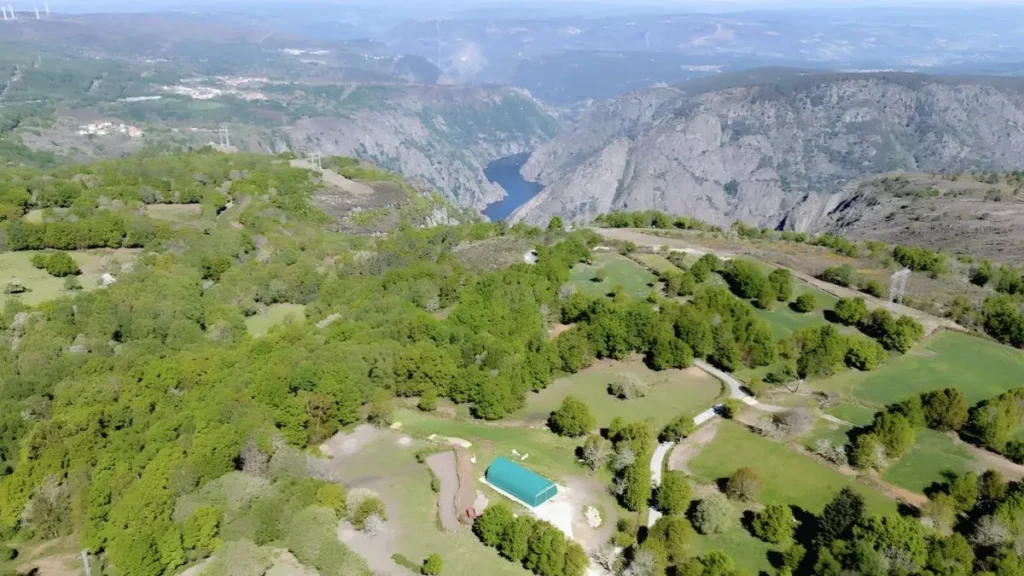
Sometimes the cows graze right by the road, and tourists stop to photograph them. Once, while we were moving the herd across the road, a couple stopped their car and got out, so I invited them into the field, and they took photo after photo. Plenty of cars pass the farm, because we’re very close to the Mirador de Cabezoás. Whether people see the cows depends on where they’re grazing that day.
Q. You also work for many farms in the area. How many will still be going in ten years?
Most of them have no one to take over, so I’d say most will close. Some owners are around fifty, which still leaves them a few years, and there are young people like us, but not many. Ten years from now we’ll see how many are left.
Q. You say you can’t find anyone to work. What would it take for someone young to do what you did?
People say there’s no work, but there is. What’s missing is the will to work. We have enough work to keep someone on full-time, but people come for a season and then lose interest: they stop answering your calls, or say they’ll come and never turn up. And the work isn’t monotonous; it changes all the time. Everyone wants to be a civil servant in an office. Farming has its good side and its bad side, like any job.
Q. Six cows to forty in five years. Where’s the ceiling?
We’ve more or less reached it. More cows need more land, and we don’t have any more. Cows eat a great deal: we need fields for hay as well as for grazing. So for now we’ll stay as we are.
Q. The calves go to the slaughterhouse in O Carballiño, and the meat is sold without your name. Would you sell it yourselves?
It wouldn’t be a bad idea, and I’d like to, but pasiño a pasiño, one step at a time.
Q. And if someone from the city told you tomorrow they wanted to do the same?
To go slowly, as we did. Starting big today is almost impossible: everything costs far more than when we began, and the investment is huge. Start with a few cows and grow from there. The older people will tell you it’s endless work, because they remember how it used to be, when everything was done by hand and the cows had to be brought in. Now there are tractors and plenty of machinery, and the cows live outdoors. It’s a different way of life.
Fire Round
A place
The miradoiros, which are beautiful. The Miradoiro do Castro, for one.
A dish and a wine
Cocido, with a mencía.
A route
From Sacardebois to the medieval necropolis of San Vítor de Barxacova (the route of the tombs).
A word
Impressive.
All photos courtesy of Ganadería Rocío Prol. Not for reproduction without written permission.