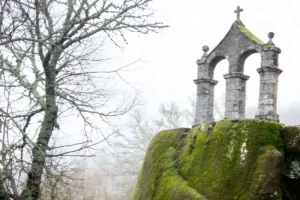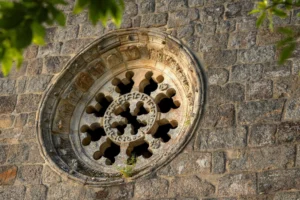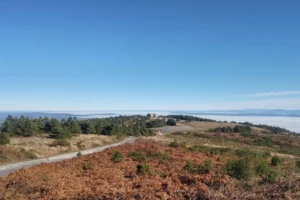
Turismo de Galicia lists the Feira das Cabras on the third Sunday of September, during the festival of San Cibrao in the parish of Merlán, in Chantada, so we came on the third Sunday. There seemed to be nobody about. The road led on to the chapel of San Cibrao at A Torre, where a panel describes the fair in three languages. The English one puts it on the third Monday.
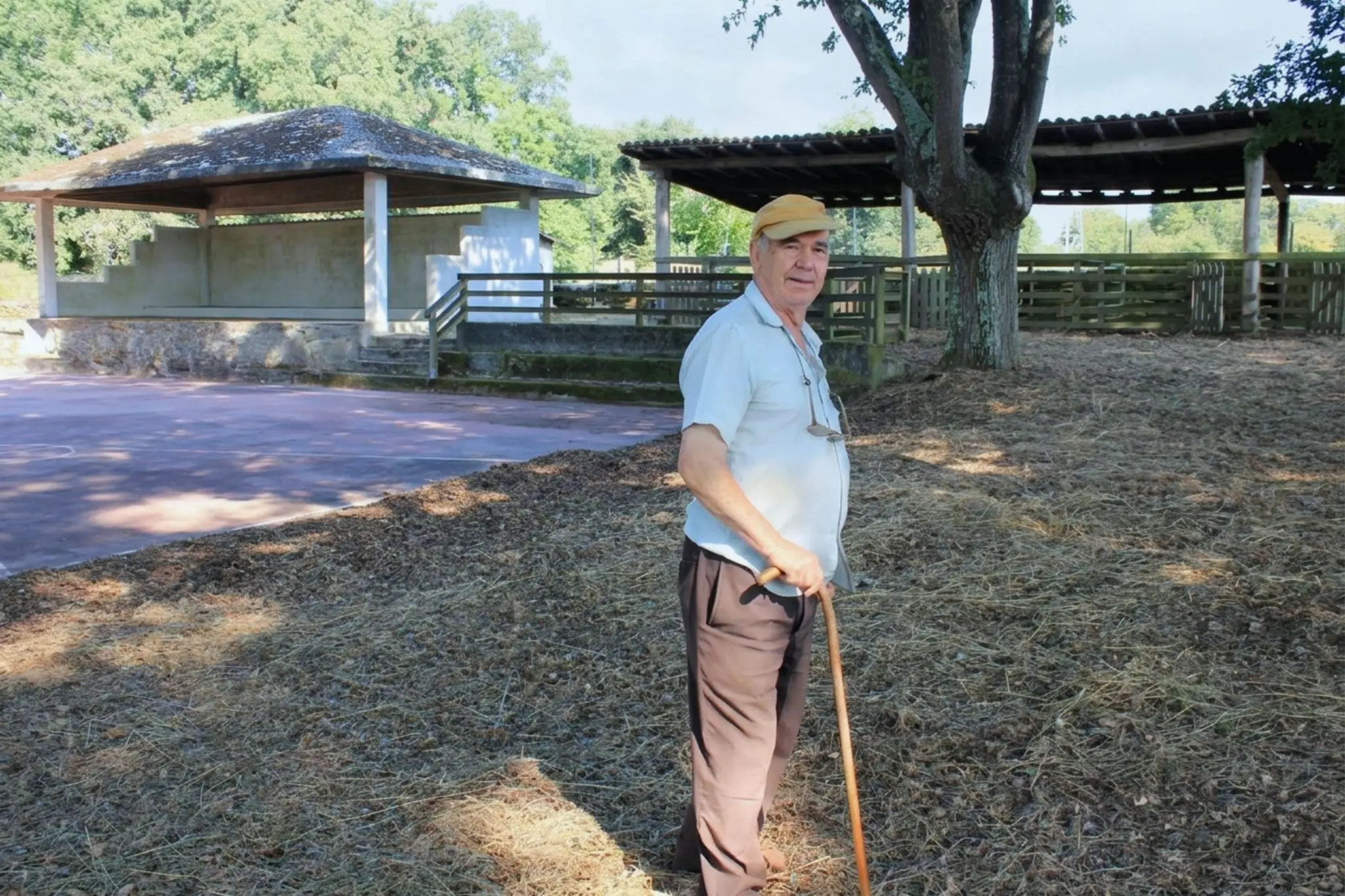
Pablo was sitting on a low wall across the road, level with the chapel, not waiting for anyone. He is seventy-eight, from Extremadura, and has lived here thirty-four years with a wife from the village; for eighteen of them he drove a taxi. He took his stick and walked us to the fair ground.
What the Goats Were For
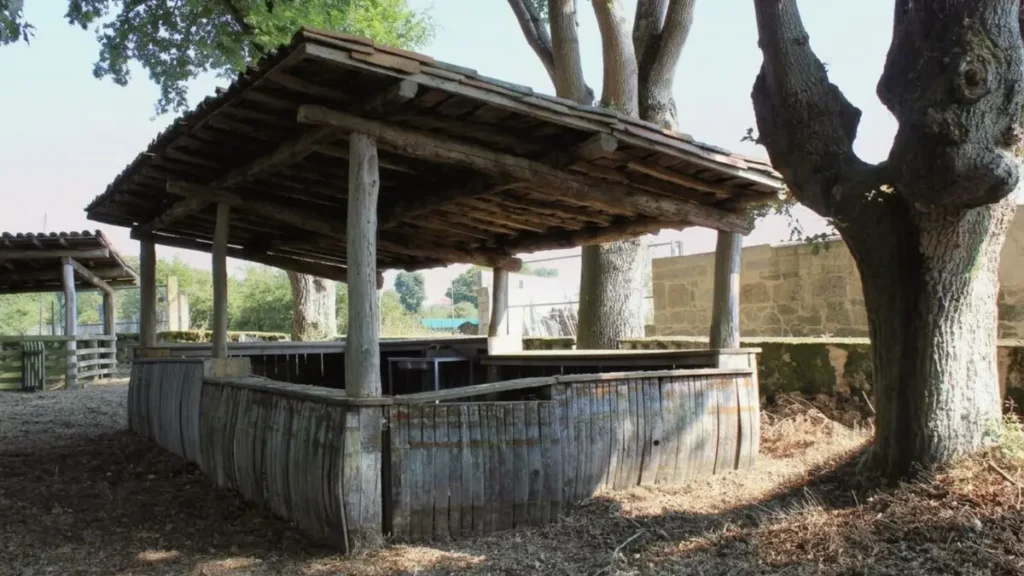
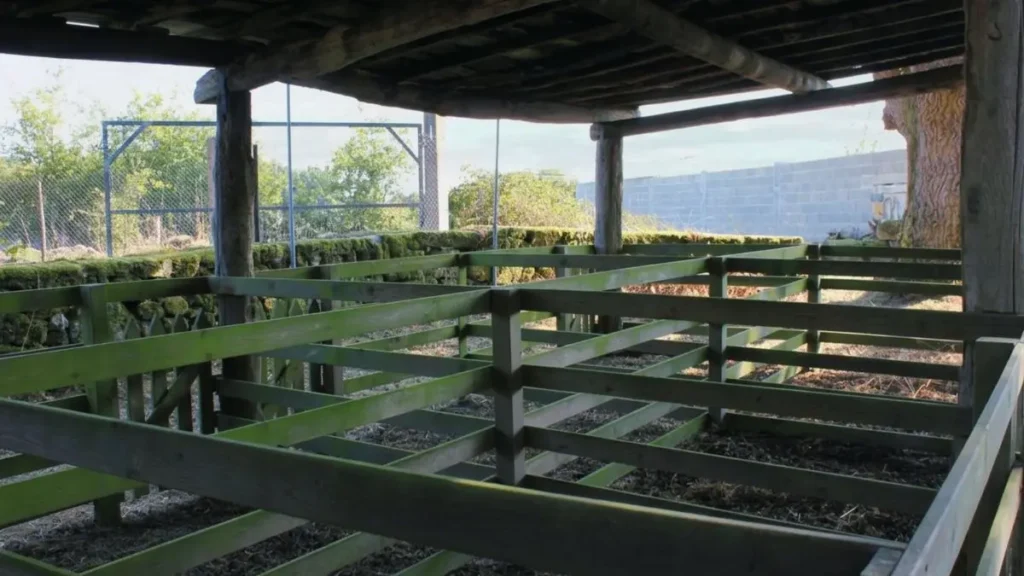
The ground is a carballeira with a basketball court, a concrete bandstand and, under a long tiled roof on chestnut posts, the pens: a grid of railed stalls, each with its own gate so the animals could be kept apart, bedded with straw. In a good year a hundred and more goats came through, some by lorry from across the river. Beside the pens stands the bar the organisers built, its counter walled with the curved staves of old wine barrels. A red beer freezer is still behind it. “We made all of this ourselves,” Pablo said.
A local historian dates the Feira das Cabras to the seventeenth or eighteenth century. It was once held on the sixteenth of every month; the one that survived is September’s, and September is the vendimia. Goats were bought and eaten through the harvest, and their skins became the odres in which wine was carried up from the riverside presses to the houses, when the thing that carried it was a mule.
Twenty-Seven Thousand Euros
From 2006 the parish neighbours’ association set out to revive the fair. Pablo ran it for about ten years, never alone: always five or six neighbours with him. Twenty-seven thousand euros for the festival, held mid-week. Five or six thousand for an orchestra, and that for a middling one. The money came door to door, and from Chantada’s shops, which gave a hundred or two hundred euros each for a logo on the poster. Those who had moved to A Coruña and Santiago gave two or three hundred, but only on a weekend; mid-week they could not come. So the fair moved to the weekend and ran the whole of it.
The vet from first thing, checking every animal’s ear tags. Three or four goats driven to the abattoir in Monforte and back the same day, for a free tasting. Four or five women stewing the meat all morning. Goat’s milk and cheese, free wine from the Ribeira Sacra, and a queue that reached the road. Goats changed hands too, but Pablo says bringing the goats was never the hard part. The hard part was everything that came with them.
In the last years they brought Orquesta Panorama, which arrived on three trailers too big for the carballeira; Pablo had them parked in a field by the road. In his final year the older residents asked for a brass band as well, and it played to an empty ground. “¿Para qué toca la banda?” he says. “For you, for me, or for the oaks?”
The organisers took nothing. On the last night the six of them ate at the bar and paid fourteen euros each. Afterwards, some neighbours said they had kept the money.
What Gets Protected
Unlike the Folión de Carros — the parade of floats that brings Chantada to a standstill for a full day in August — the Feira das Cabras has never been declared a Festa de Interese Turístico or a Ben de Interese Cultural. From the town hall it received the same small subsidy as any village festa; the rest came from the goodwill of the people of Merlán. This was goat country once; the only herd Pablo can name now is a friend’s, twelve animals.
Back at the chapel, José Luis joined us. His grandfather was the Camilo Fernández whose widow raised the granite peto de ánimas in 1948. He remembers the goatskins: ten or twelve of them hanging in his mother’s house up the hill, ready for the vendimia. His cousins are restoring that house now for rural tourism. He tells the fair’s recent history as Pablo does: stopped for covid, back in 2023 with around a hundred goats, not held for the last two years.
Between them, Pablo and José Luis have heard that two young men want to take the fair on next year. When the fair ran, the goats walked in the procession after the one o’clock mass. This year the mass was at one, and the pens under the chestnut roof were bedded with straw and empty.
Pablo at the fair ground; The bar the organisers built, The pens, bedded with straw — photos by P. Vanossi.