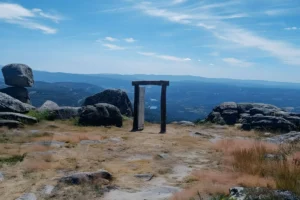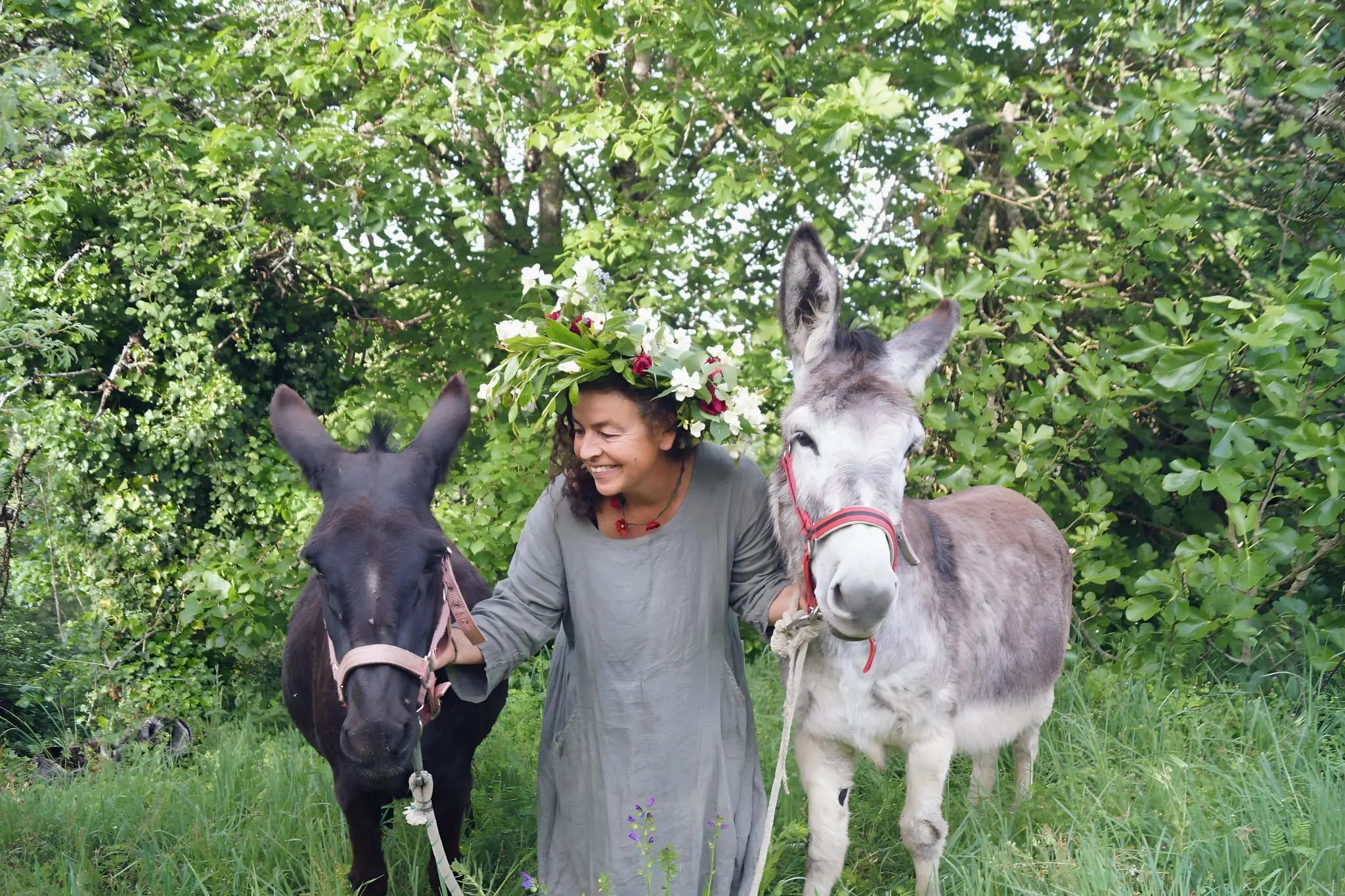
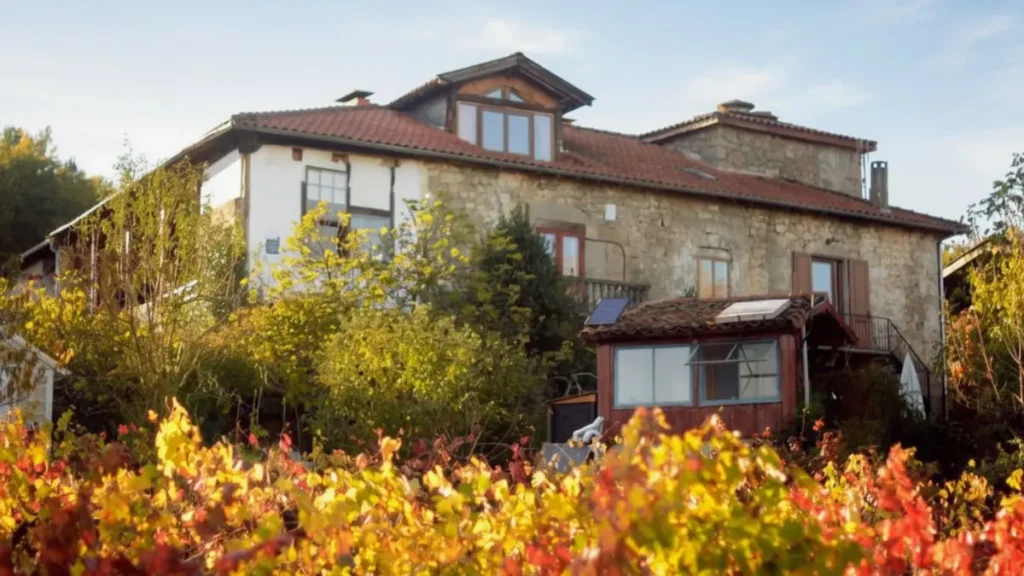
The Ecofinca Tanquián sits on five and a half hectares above the village of Deade, in Pantón — oak forest, vineyard, gardens and orchard, run for thirty-five years as one of the older permaculture projects in Galicia. You leave the car a stone’s throw from the house and arrive on foot, the way Emmely likes it, with the vehicles kept out of sight of the land. German-Turkish — an organic farmer, composter, maker of outdoor sculpture — she came looking for an uncomplicated place to learn how to live off the land, and somewhere quiet to raise children within reach of the trees. She is still here. The children grew up; one of them, May, teaches yoga across the comarca. These days the medieval tower on the property is let to travellers and volunteers arrive to learn how the place works, as the finca shifts slowly from one that grows food to one that helps people reconnect — with nature and with themselves — through yoga, food, and the daily practice of living here. A few minutes downhill, the Cistercian monastery of Ferreira, where nuns have kept time unbroken for centuries, makes a fitting neighbour for a place measured in decades.
Q. Thirty-five years is a long time to stay. What holds you?
I have a very strong relationship with the ground. It sustains me, it teaches me, and it never abandons me. Our area is special for the diversity of its microclimates, and because the old culture is dying — leaving room for something new that isn’t defined yet. The difficulty of finding work and the cold winters act as a filter for the people who try to live here. You need a fair amount of conviction and endurance to manage it. But it’s worth the effort.
Q. Plenty of organic farms say they work with the land. What does Tanquián do that a conventional eco-farm wouldn’t?
Remember that Bill Mollison‘s permaculture manual only came out in 1988 — so with our project I think we count among the pioneers in Spain, and certainly in the Ribeira Sacra. What makes Tanquián special is continuity. Permaculture initiatives and holistic projects in the countryside have a high potential for failure, because of the difficulties you meet along the way. We’ve survived all of it, and that’s why we can teach so many things that are already done, already tested. Because the focus was always on creating more harmony between us and the land — not on big production — we were able to adjust our practices continuously to whatever the experience taught us.
Q. Give us two or three concrete decisions that come from permaculture rather than habit.
A few years ago we sowed zinnias among the tomatoes, and both grew better than usual — now I do it every time. We have around a hundred fruit trees and we hardly prune them, letting the branches lean down onto the ground. That saves months of work, and you don’t need to prop them so they won’t break. Of the five and a half hectares, two are native oak forest. We keep that space by never taking more than ten percent of the wood a year and respecting the old trees. So the caballeira grows more beautiful each year, while the house stays warm in winter.
Q. After three decades, what has the land taught you that the books didn’t?
That there are no universal solutions. Books give you very useful ideas, but practice decides. Every place is different — what works for me might not work for my friend fifty kilometres away, simply because of differences in soil, in the history of the ground, the abuse it’s had, the microclimate. To enjoy this kind of life you have to be flexible and react to what happens, with the land and with people both. The obsession with specialising, in this society, is a fatal mistake — nature always chooses diversity. And the other necessary thing is in our own heads: a humble attitude before nature. Everything has a right to exist, even “the pests.” I’m just another pest — maybe the worst of all. Failure doesn’t exist; there are only lessons that help you understand the system you’re tending. That’s the only way we learn.
Q. If a traveller who knows nothing about permaculture spends a morning here, what would you show them first?
I’d take them to the dry toilet — so they can see how beautiful it can be when your waste is turned into fertile soil instead of contaminating drinking water. With good views, too.
Q. What does this place have that you haven’t found anywhere else — and what is it still missing?
Here the forest just grows, no fuss! It’s the ideal place in Europe to eat from your own garden and take part in building a local economy. What’s missing is people — people with awareness and the joy of being able to live in the countryside. It would help if the authorities valued that and made it easier for young people to arrive, with real possibilities for work and housing. We’re short of every basic trade, and of families with children living here for good. Tourism and selling houses to summer people push prices up and block any sustainable development — that’s the part nobody wants to hear, but it’s true.
Q. Your website mentions the second generation getting more involved. What passes from one generation to the next?
Knowledge passes through practice — to the children and to everyone else. Respect for nature is innate in every child; you only have to cultivate it. People who spend their childhood in intimate contact with nature take it in as the base of their personality, and whatever their life is afterward, they can’t erase it. In our case, the young ones see the future of this place more as a site of healing and teaching than of agricultural production. It’s the next step — honouring what we’ve built here. What stays is the close bond with nature, and the trust that the land sustains all of us.
The future of this place isn’t only in tourism and wine — it’s in the people who chose to live here, close to the land. And we keep growing.
Q. What’s coming up that readers should know about?
We have a mutual-aid group, “as Toupas” — the moles — that I value enormously. We help each other with the practical jobs that need many hands, and that work builds deep, lasting relationships. There’s also a new cultural event, an open mic, where anyone can take part — every Saturday, in a different spot around the area.
Fire Round
A place
Ecofinca Tanquián — my own home.
A dish
Most of the plants growing here are edible. Try whatever you find along the path.
A route
Vilanova to Serode, past Tanquián and Casandiño, down to Lina’s cantina — on foot only.
A word
Paradise at the end of the world.
A misconception
That you can see it in a weekend. Stay a while — get lost in it, and let it show you something.
All photos courtesy of Emmely Fohring. Not for reproduction without written permission.