~29 km drive · 4 stops · ~5 hours · Start: Chantada · End: O Saviñao (Cabo do Mundo)
The road from Chantada down to the Belesar reservoir runs through one of the strangest concentrations of Romanesque architecture in Galicia, but not because it is the densest — that title belongs to Pantón a few valleys south. The route along the upper Miño is something else. It is the corridor where rural parish churches were built by stonemasons who had just finished, or were about to finish, the Pórtico da Gloria in Compostela. The connection is not folklore. Specialists have linked the workshop of Maestro Mateo to four churches on this stretch of river, and three of them sit on this drive.
Leave Chantada on the LU-533 east, towards Monforte. Within ten minutes a small sign points left into a chestnut wood. Park at the roadside — there is no formal lot — and walk the last half kilometre on foot. Santa María de Pesqueiras appears in a clearing, hidden so completely by the forest that the only access is the path itself. It is a twelfth-century former Benedictine nunnery, declared Monumento Nacional in 1950, with a semicircular apse and a series of sixteenth-century murals inside — Resurrection of the Dead, Last Judgement — that the building’s isolation has done more to preserve than any conservation programme. The walk in and out takes about thirty minutes. Treat it as part of the route, not an inconvenience.
Back on the road, cross the Belesar dam and turn south along the eastern bank to Santo Estevo de Ribas de Miño. The four-metre rosette will be visible before you have parked. This is one of the largest Romanesque rose windows in Galicia, set above a doorway whose inner archivolt holds seven seated elders with musical instruments — King David and his retinue, rendered in a composition that has been read against the Pórtico da Gloria for over a century. The interior is closed except by booking through the Consorcio de Turismo da Ribeira Sacra. The façade alone justifies the stop.
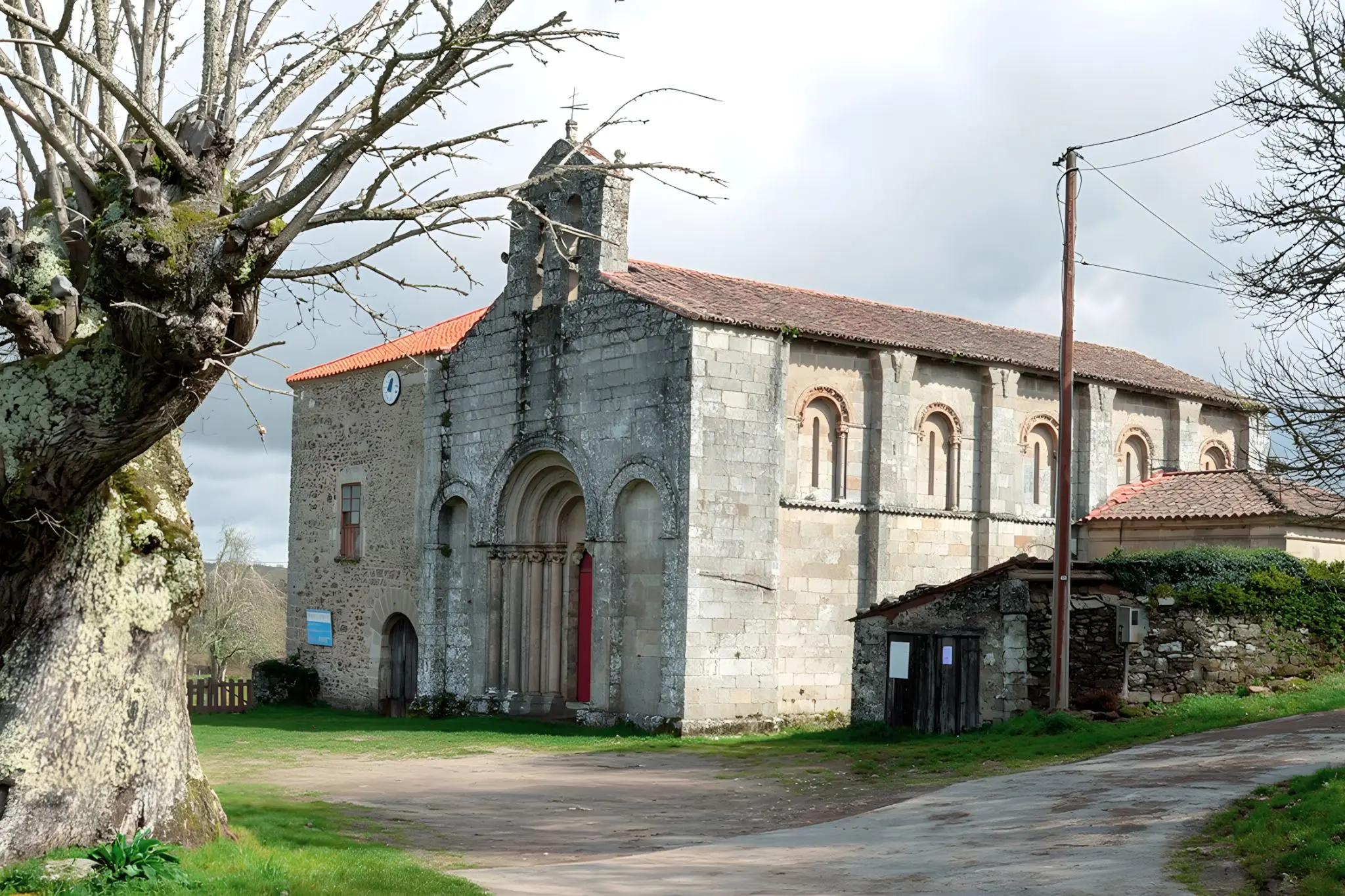
Continue along a narrow road south to San Paio de Diomondi, the largest Romanesque church in O Saviñao and the one with the most layered afterlife. Its consecration is dated 1170 by an inscription on the façade. The Benedictine monastery here was absorbed by the Bishop of Lugo in the late fourteenth century and the adjoining buildings became an episcopal summer palace. They now house an albergue for pilgrims on the Camiño de Inverno, the inland branch of the Camino that comes through Diomondi on its way to Compostela. The capitals — birds, hybrid beasts, vegetal interlace — are the closest thing on the route to the Platerías workshop of the cathedral. Sunday noon mass is the reliable way in; otherwise the Consorcio handles bookings.
The last stop is the longest drive, about fifteen minutes south through Escairón and out along the spur road towards Cabo do Mundo. San Martiño da Cova stands above the meander on a vineyard slope, smaller and quieter than what came before. A former Augustinian priory suppressed in 1824, late twelfth century, plain tympanum, carved canecillos along the eaves. The church reads as the route’s coda — parish-scale Romanesque after three monumental ones, which is the right order. From here it is five minutes by car to the Miradoiro do Cabo do Mundo and another two to Praia da Cova, where the loop ends at river level, looking back up at everything you just drove.
April or November are the strong months: green vines or full reservoir. Allow five hours rather than four if you want to walk to Pesqueiras and stop properly at each church; closer to six if Diomondi opens on a Sunday and you go inside. Pack lunch — there is nowhere to buy one between Chantada and Escairón. The fuel station in Escairón is the only one on the route.
Romanesque Church of San Paio de Diomondi — photo by M. D. Paderne Sanchez, edited with AI.